pyAgrum.causal documentation
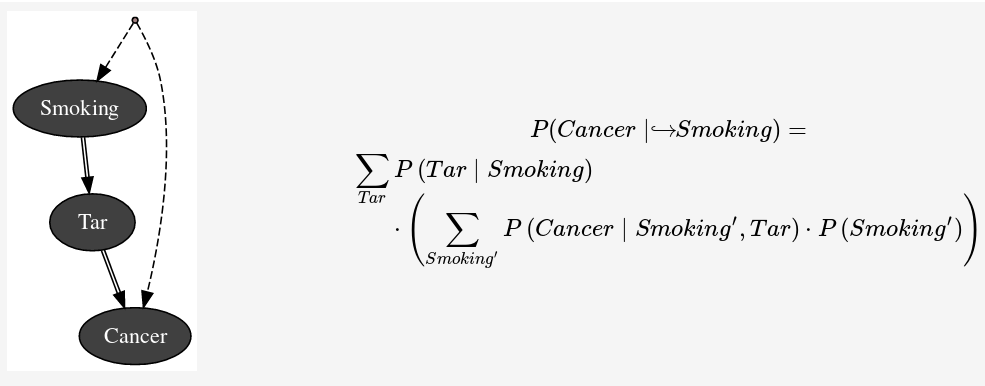
Causality in pyAgrum mainly consists in the ability to build a causal model, i.e. a (observational) Bayesian network and a set of latent variables and their relation with observation variables and in the abilidy to compute using do-calculus the causal impact in such a model.
Causality is a set of pure python3 scripts based on pyAgrum’s tools.
Note
As it can be seen in the figure above, pyAgrum.causal module uses a LaTeX special arrow (\(\hookrightarrow\)) to compactly represent an intervention. If you prefer the classical “do” notation, you can change this behavior by using:
gum.config["causal","latex_do_prefix"]="do("
gum.config["causal","latex_do_suffix"]=")"
Tutorials
Some implemented examples from the book of Why from Judea Pearl and Dana Mackenzie.
Reference
- Causal Model
CausalModelCausalModel.addCausalArc()CausalModel.addLatentVariable()CausalModel.arcs()CausalModel.backDoor()CausalModel.causalBN()CausalModel.children()CausalModel.eraseCausalArc()CausalModel.existsArc()CausalModel.frontDoor()CausalModel.idFromName()CausalModel.latentVariablesIds()CausalModel.names()CausalModel.nodes()CausalModel.observationalBN()CausalModel.parents()CausalModel.toDot()
- Causal Formula
- Causal Inference
- Other functions
- Abstract Syntax Tree for Do-Calculus
- Exceptions
- Notebook’s tools for causality