Sensitivity analysis for Bayesian networks using credal networks

Creative Commons License

aGrUM

interactive online version

There are several sensitivity analysis frameworks for Bayesian networks. A fairly efficient method is certainly to use credal networks to do this analysis.

Creating a Bayesian network

In [1]:
import pyagrum as gum
import pyagrum.lib.notebook as gnb
In [2]:
bn = gum.fastBN("A->B->C<-D->E->F<-B")
gnb.flow.row(bn, gnb.getInference(bn))
G E E F F E->F C C D D D->E D->C A A B B A->B B->C B->F
structs Inference in   0.58ms A 2025-07-24T00:06:39.373464 image/svg+xml Matplotlib v3.10.3, https://matplotlib.org/ B 2025-07-24T00:06:39.426028 image/svg+xml Matplotlib v3.10.3, https://matplotlib.org/ A->B C 2025-07-24T00:06:39.469884 image/svg+xml Matplotlib v3.10.3, https://matplotlib.org/ B->C F 2025-07-24T00:06:39.656374 image/svg+xml Matplotlib v3.10.3, https://matplotlib.org/ B->F D 2025-07-24T00:06:39.514706 image/svg+xml Matplotlib v3.10.3, https://matplotlib.org/ D->C E 2025-07-24T00:06:39.613456 image/svg+xml Matplotlib v3.10.3, https://matplotlib.org/ D->E E->F

Building a credal network from a BN

It is easy to build a credal network from a Bayesian network by indicating the ‘noise’ on each parameter.

In [3]:
cr = gum.CredalNet(bn, bn)
gnb.show(cr)
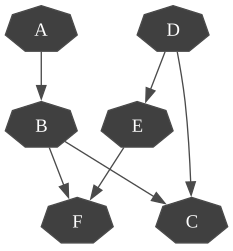
../_images/notebooks_14-Examples_SensitivityAnalysisUsingCredalNetworks_6_0.svg
In [4]:
cr.bnToCredal(1e-10, False, False)
In [5]:
cr.computeBinaryCPTMinMax()
In [6]:
print(cr)

A:Range([0,1])
<> : [[0.47151 , 0.52849] , [0.471373 , 0.528627]]

B:Range([0,1])
<A:0> : [[0.851844 , 0.148155]]
<A:1> : [[0.838713 , 0.161286]]

C:Range([0,1])
<B:0|D:0> : [[0.475124 , 0.524876] , [0.474994 , 0.525006]]
<B:1|D:0> : [[0.376467 , 0.623533] , [0.375825 , 0.624175]]
<B:0|D:1> : [[0.814865 , 0.185135] , [0.814864 , 0.185136]]
<B:1|D:1> : [[0.625365 , 0.374635] , [0.625351 , 0.374649]]

D:Range([0,1])
<> : [[0.924586 , 0.0754136]]

E:Range([0,1])
<D:0> : [[0.536533 , 0.463467] , [0.536482 , 0.463518]]
<D:1> : [[0.437852 , 0.562148] , [0.437618 , 0.562382]]

F:Range([0,1])
<E:0|B:0> : [[0.973344 , 0.0266562]]
<E:1|B:0> : [[0.469385 , 0.530615] , [0.469243 , 0.530757]]
<E:0|B:1> : [[0.47502 , 0.52498] , [0.47489 , 0.52511]]
<E:1|B:1> : [[0.182131 , 0.817869] , [0.133535 , 0.866465]]


Testing difference hypothesis about the global precision on the parameters

We can therefore easily conduct a sensitivity analysis based on an assumption of error on all the parameters of the network.

In [7]:
def showNoisy(bn, beta):
  cr = gum.CredalNet(bn, bn)
  cr.bnToCredal(beta, False, False)
  cr.computeBinaryCPTMinMax()
  ielbp = gum.CNLoopyPropagation(cr)
  return gnb.getInference(cr, engine=ielbp)
In [8]:
for eps in [1, 1e-1, 1e-2, 1e-3, 1e-10]:
  gnb.flow.add(showNoisy(bn, eps), caption=f"noise={eps}")
gnb.flow.display()
structs Inference in   0.62ms A 2025-07-24T00:06:40.152184 image/svg+xml Matplotlib v3.10.3, https://matplotlib.org/ B 2025-07-24T00:06:40.195561 image/svg+xml Matplotlib v3.10.3, https://matplotlib.org/ A->B C 2025-07-24T00:06:40.232854 image/svg+xml Matplotlib v3.10.3, https://matplotlib.org/ B->C F 2025-07-24T00:06:40.343291 image/svg+xml Matplotlib v3.10.3, https://matplotlib.org/ B->F D 2025-07-24T00:06:40.269600 image/svg+xml Matplotlib v3.10.3, https://matplotlib.org/ D->C E 2025-07-24T00:06:40.306132 image/svg+xml Matplotlib v3.10.3, https://matplotlib.org/ D->E E->F
noise=1
structs Inference in   0.22ms A 2025-07-24T00:06:40.487311 image/svg+xml Matplotlib v3.10.3, https://matplotlib.org/ B 2025-07-24T00:06:40.524863 image/svg+xml Matplotlib v3.10.3, https://matplotlib.org/ A->B C 2025-07-24T00:06:40.562394 image/svg+xml Matplotlib v3.10.3, https://matplotlib.org/ B->C F 2025-07-24T00:06:40.678068 image/svg+xml Matplotlib v3.10.3, https://matplotlib.org/ B->F D 2025-07-24T00:06:40.603878 image/svg+xml Matplotlib v3.10.3, https://matplotlib.org/ D->C E 2025-07-24T00:06:40.640901 image/svg+xml Matplotlib v3.10.3, https://matplotlib.org/ D->E E->F
noise=0.1
structs Inference in   0.24ms A 2025-07-24T00:06:40.823437 image/svg+xml Matplotlib v3.10.3, https://matplotlib.org/ B 2025-07-24T00:06:40.861114 image/svg+xml Matplotlib v3.10.3, https://matplotlib.org/ A->B C 2025-07-24T00:06:40.899099 image/svg+xml Matplotlib v3.10.3, https://matplotlib.org/ B->C F 2025-07-24T00:06:41.014991 image/svg+xml Matplotlib v3.10.3, https://matplotlib.org/ B->F D 2025-07-24T00:06:40.936546 image/svg+xml Matplotlib v3.10.3, https://matplotlib.org/ D->C E 2025-07-24T00:06:40.974330 image/svg+xml Matplotlib v3.10.3, https://matplotlib.org/ D->E E->F
noise=0.01
structs Inference in   0.23ms A 2025-07-24T00:06:41.264762 image/svg+xml Matplotlib v3.10.3, https://matplotlib.org/ B 2025-07-24T00:06:41.302151 image/svg+xml Matplotlib v3.10.3, https://matplotlib.org/ A->B C 2025-07-24T00:06:41.339583 image/svg+xml Matplotlib v3.10.3, https://matplotlib.org/ B->C F 2025-07-24T00:06:41.452103 image/svg+xml Matplotlib v3.10.3, https://matplotlib.org/ B->F D 2025-07-24T00:06:41.376928 image/svg+xml Matplotlib v3.10.3, https://matplotlib.org/ D->C E 2025-07-24T00:06:41.414695 image/svg+xml Matplotlib v3.10.3, https://matplotlib.org/ D->E E->F
noise=0.001
structs Inference in   0.22ms A 2025-07-24T00:06:41.604343 image/svg+xml Matplotlib v3.10.3, https://matplotlib.org/ B 2025-07-24T00:06:41.641196 image/svg+xml Matplotlib v3.10.3, https://matplotlib.org/ A->B C 2025-07-24T00:06:41.678119 image/svg+xml Matplotlib v3.10.3, https://matplotlib.org/ B->C F 2025-07-24T00:06:41.790121 image/svg+xml Matplotlib v3.10.3, https://matplotlib.org/ B->F D 2025-07-24T00:06:41.716206 image/svg+xml Matplotlib v3.10.3, https://matplotlib.org/ D->C E 2025-07-24T00:06:41.752971 image/svg+xml Matplotlib v3.10.3, https://matplotlib.org/ D->E E->F
noise=1e-10
In [ ]: