Object-Oriented Probabilistic Relational Model
|
|
|



In [1]:
import os

os.chdir("res")

import pyagrum as gum
import pyagrum.lib.notebook as gnb
O3PRM is inspired by relational language, directly based on the BN and improved by object oriented paradigms, where the focus is set on classes of objects and by defining relations among these objects (see http://o3prm.gitlab.io/ for more details)
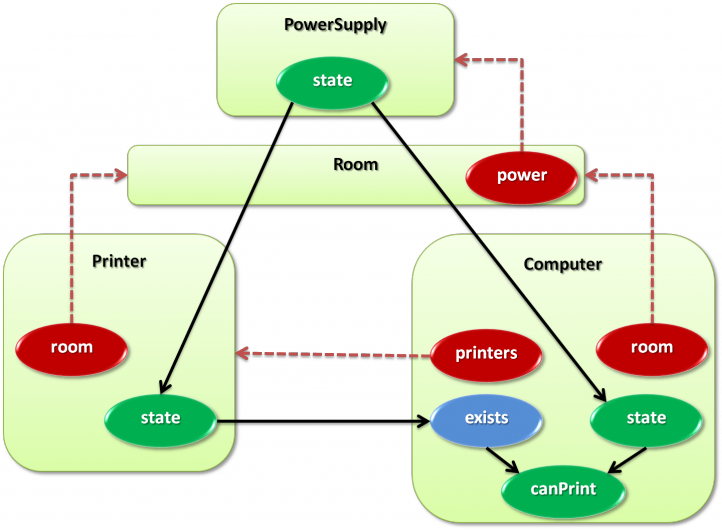
O3PRM syntax
In [2]:
with open("./Asia.o3prm", "r") as prm:
  for line in prm.readlines():
    print(line, end="")
class Asia {

    boolean visitToAsia {
        [ 0.99,  // False
          0.01 ] // True
    };

    boolean tuberculosis dependson visitToAsia {
        // False | True
        [    0.99, 0.95,  // False
             0.01, 0.05 ] // True
    };

    boolean smoking {
        [ 0.50,  // False
          0.50 ] // True
    };

    boolean lungCancer dependson smoking {
        // False | True => smoking
        [    0.99, 0.90,  // False
             0.01, 0.10 ] // True
    };

    boolean bronchitis dependson smoking {
        // False | True => smoking
        [    0.70, 0.40,  // False
             0.30, 0.60 ] // True
    };

    boolean tubOrCancer dependson tuberculosis, lungCancer {
        //      False    ||     True      => tuberculosis
        //  False | True || False | True  => lungCancer
        [     1.00, 0.00,     0.00, 0.00,  // False
              0.00, 1.00,     1.00, 1.00 ] // True
    };

    boolean positiveXRay dependson tubOrCancer {
        // False | True => tubOrCancer
        [ 0.95, 0.02,  // False
          0.05, 0.98 ] // True
    };

    boolean dyspnea dependson tubOrCancer, bronchitis {
        //      False    ||     True      => tubOrCancer
        //  False | True || False | True  => bronchitis
        [     0.90, 0.20,     0.30, 0.10,  // False
              0.10, 0.80,     0.70, 0.90 ] // True
    };
}
Using o3prm syntax for creating BayesNet
In [3]:
bn = gum.loadBN("./Asia.o3prm", verbose=False)
bn
Out[3]:
In [4]:
bn = gum.loadBN("./aSys.o3prm")
bn
Out[4]:
In [5]:
classpath = "./ComplexPrinters"
filename = "./ComplexPrinters/fr/lip6/printers/system.o3prm"

system = "Work"
bn = gum.loadBN(filename, system=system, classpath=classpath)
In [6]:
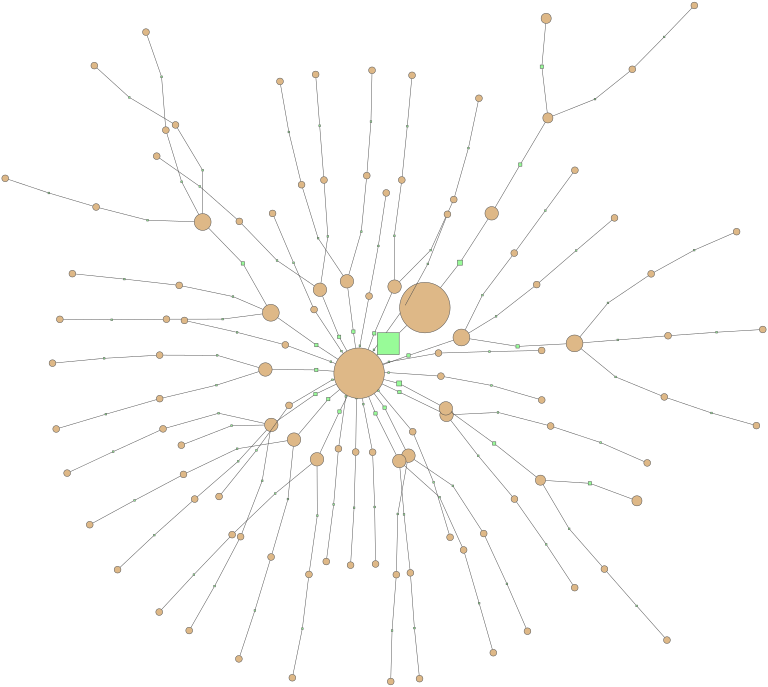
# the inference will take place in a rather large junction tree
gnb.showJunctionTreeMap(bn, scaleClique=0.1, scaleSep=0.05, lenEdge=1.2, size="8!")
In [8]:
gum.saveBN(bn, "bnprinters.bifxml")
In [9]:
bn2 = gum.loadBN("bnprinters.bifxml")
gnb.showInference(bn2, size="25!")

In [ ]:
# if cairosvg is installed, one can export a graph (or inference) as a pdf
# gnb.exportInference(bn,filename="../out/ComplexPrinters.pdf")
In [ ]:
bn = gum.loadBN("./aSys.o3prm")
gnb.sideBySide(gnb.getBN(bn, size="5"), gnb.getInference(bn, size="5"))
Exploring Probabilistic Relational Model
In [ ]:
classpath = "./ComplexPrinters"
filename = "./ComplexPrinters/complexprinters_system.o3prm"
explor = gum.PRMexplorer()
explor.load(filename)
In [ ]:
for cl in explor.classes():
  print("Class : " + cl)
  print("  - Super class : " + ("None" if explor.getSuperClass(cl) == None else explor.getSuperClass(cl)))
  print("  - Implemented interface : ")
  for inter in explor.classImplements(cl):
    print("      " + inter)
  print("  - Direct sub-types : ")
  for ext in explor.getDirectSubClass(cl):
    print("      " + ext)
  print("  - Attributes : ")
  for t, n, depensons in explor.classAttributes(cl):
    s = ""
    for depenson in depensons:
      s = s + depenson + " "
    print("      " + t + " " + n + " (" + s + ")")
  print("  - References : ")
  for t, n, isArray in explor.classReferences(cl):
    print("      " + t + ("[]" if isArray else "") + " " + n)
  print("  - Aggragates : ")
  for t, n, g, l, slots in explor.classAggregates(cl):
    s = ""
    for slot in slots:
      s = s + slot + " "
    print("      " + t + " " + n + " " + g + " " + ("NoLabel" if l == None else l) + " (" + s + ")")
  print("  - SlotChains : ")
  for t, n, isMultiple in explor.classSlotChains(cl):
    print("      " + t + " " + n + " " + ("[]" if isMultiple else ""))
  print("  - Parameters : ")
  for param in explor.classParameters(cl):
    print("      " + param)
  # print("  - Dag : ")
  # (dic, dotString) = explor.classDag(cl)
  # print(dic)
  # print(dotString)

  print()
In [ ]:
print("The following lists the systems of the prm:\n")
systems = explor.getalltheSystems()
sys1 = systems[0]
print("Name of the system: " + sys1[0] + "\n")
print("Nodes : dict(id: [name,type])")
print(sys1[1])
print("\n")
print("Arcs : List[(tail, head),(tail, head)...]")
print(sys1[2])
In [ ]:
gnb.showTensor(explor.cpf("Computer", "equipState"))
In [ ]:
for cl in explor.types():
  print("Type : " + cl)
  print("  - Super type : " + ("None" if explor.getSuperType(cl) == None else explor.getSuperType(cl)))
  print("  - Direct sub-types : ")
  for name in explor.getDirectSubTypes(cl):
    print("      " + name)
  print("  - Labels : ")
  for t in explor.getLabels(cl):
    print("      " + t)
  print("  - Labels mapping : ")
  for key, val in dict().items() if explor.getLabelMap(cl) == None else explor.getLabelMap(cl).items():
    print("      " + key + " -> " + val)
  print()
In [ ]:
for cl in explor.interfaces():
  print("Interface : " + cl)
  print("  - Super interface : " + ("None" if explor.getSuperInterface(cl) == None else explor.getSuperInterface(cl)))
  print("  - Direct sub-interfaces : ")
  for name in explor.getDirectSubInterfaces(cl):
    print("      " + name)
  print("  - Implementations : ")
  for impl in explor.getImplementations(cl):
    print("      " + impl)
  print("  - Attributes : ")
  for t, n in explor.interAttributes(cl, allAttributes=True):
    print("      " + t + " " + n)
  print("  - References : ")
  for t, n, isArray in explor.interReferences(cl):
    print("      " + t + ("[]" if isArray else "") + " " + n)
  print()
In [ ]:
print(explor.isType("fr.lip6.printers.base.Printer"))
print(explor.isClass("fr.lip6.printers.base.Printer"))
print(explor.isInterface("fr.lip6.printers.base.Printer"))